

Inside the Office
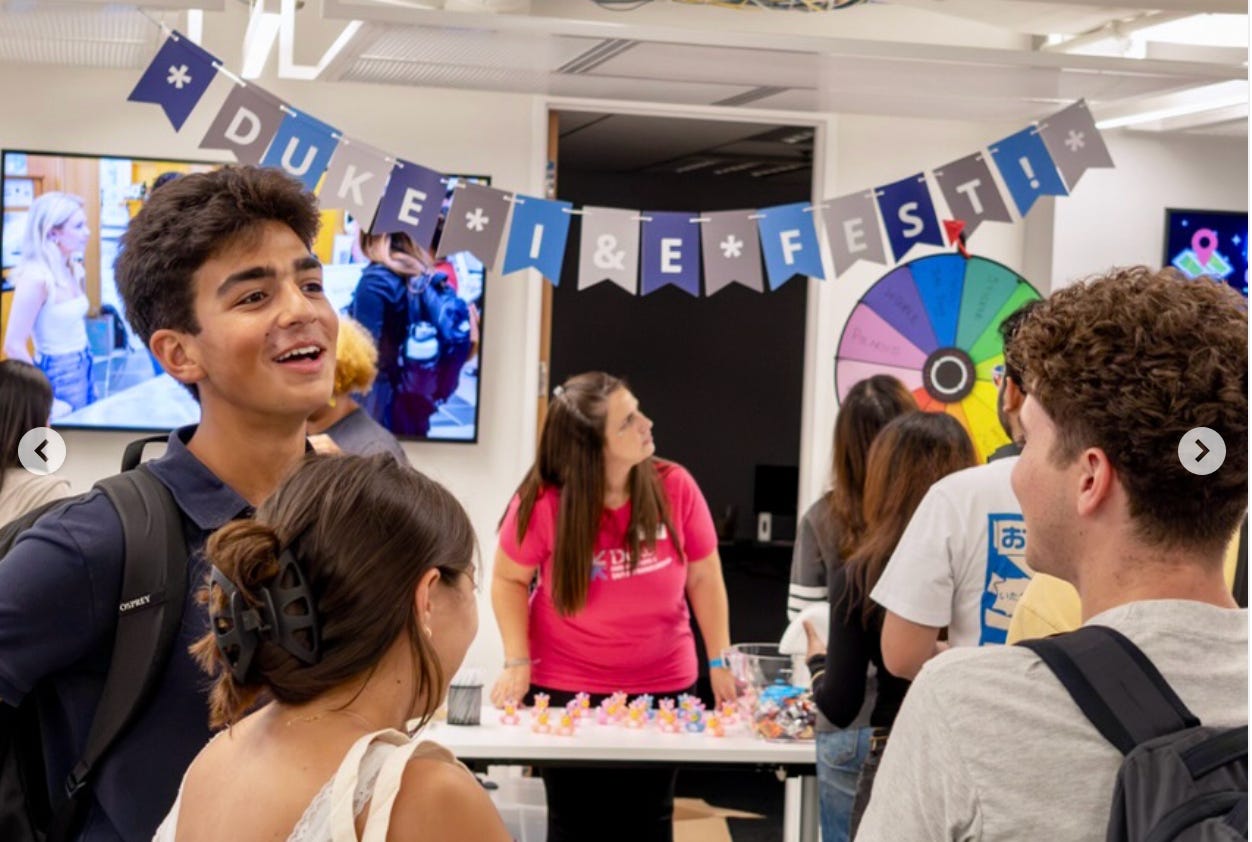
Last week was Duke I&E Fest, our annual beginning-of-the-school-year event where roughly a thousand students show up to explore all the entrepreneurial classes, clubs, programs, and opportunities scattered across campus.
While I was wandering around the event talking with students, something kept happening that, when I stop to think about it, shows the dramatic arc of entrepreneurship over the last few decades. For whatever reason, this was the first I&E Fest where dozens of freshman came up and told me some version of, “I came to Duke because of entrepreneurship.”
To be clear, I don’t mean this as a way of bragging about Duke’s entrepreneurship program. I was surprised by it because, 25 years ago, people just didn’t go to college to be entrepreneurs.
Literally… I was a freshman arriving at Duke 25 years ago (I started in the Fall of 2001) and Duke didn’t even have an entrepreneurship program. Just as importantly, I’m not sure “studying entrepreneurship” would have made much sense as a concept. Entrepreneurship was something you did after quitting your real job, which means telling your parents you wanted to spend college learning how to start companies would have probably sounded less like a curriculum and more like an expensive strategy for becoming unemployed.
Obviously that’s not entirely what entrepreneurship meant. People have been starting businesses for a long time. I imagine they’ve basically been doing it since our first cave ancestors were trying to trade mammoth tusks for tiger skins. But the general concept of entrepreneurship has, until rather recently, occupied a very different cultural position.
Fast forward a quarter century from my freshman year, and I’m standing in the middle of campus meeting 18-year-olds who chose where to attend college partly because they wanted access to entrepreneurship education.
Isn’t that a crazy shift? I even had students tell me their parents encouraged them to attend I&E Fest. That’s right… being an entrepreneur has gone from the thing parents thought meant you were unemployed to the thing that parents think is going to help you get a good job.
And what’s most interesting here isn’t just that entrepreneurship is popular. To me I’m fascinated by the way entrepreneurship has become institutionalized. Every major university now has entrepreneurship faculty and courses. Some have minors, some have majors, and/or certificates, incubators, accelerators, and competitions. A decent number of schools even have entire buildings dedicated to the subject. Which is significant because universities tend to play an important role in legitimizing fields of knowledge. Once something gets departments and professors and curricula, it means society has basically agreed it’s a “real subject.”
By the way, I’m not saying this is necessarily good for entrepreneurship. In fact, I feel like there’s something inherently strange about universities formalizing a field built around questioning established systems and conventional wisdom. In a sense, entrepreneurship has always been more about figuring out how to operate outside the rigid structures of school than be a part of them.
Still, I&E Fest was an interesting window into how much the world of entrepreneurship has changed. A generation ago, entrepreneurship was something universities barely taught, and today it’s the reason lots of students are choosing their universities. And while I’m not entirely sure what that says about where entrepreneurship is headed next, it clearly says something important about where it sits in the world now versus where it was, and, as an entrepreneurship educator, it’s definitely a fascinating shift to watch.
-Aaron
Worth Your Time
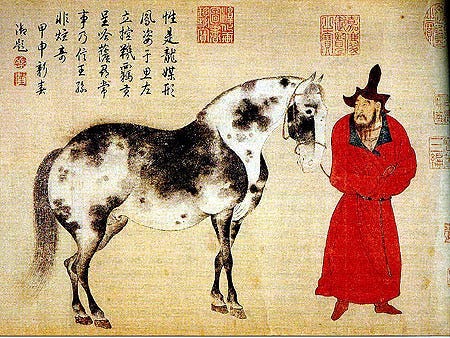
Today, rather than linking you to some big long essay or book, I wanted to share a simple story I like giving students in my entrepreneurship classes at the start of the semester.
It’s called “The Story of the Chinese Farmer” by Alan Watts:
Once upon a time there was a Chinese farmer whose horse ran away. That evening, all of his neighbors came around to commiserate. They said, “We are so sorry to hear your horse has run away. This is most unfortunate.” The farmer said, “Maybe.” The next day the horse came back bringing seven wild horses with it, and in the evening everybody came back and said, “Oh, isn’t that lucky. What a great turn of events. You now have eight horses!” The farmer again said, “Maybe.”
The following day his son tried to break one of the horses, and while riding it, he was thrown and broke his leg. The neighbors then said, “Oh dear, that’s too bad,” and the farmer responded, “Maybe.” The next day the conscription officers came around to conscript people into the army, and they rejected his son because he had a broken leg. Again all the neighbors came around and said, “Isn’t that great!” Again, he said, “Maybe.”
The whole process of nature is an integrated process of immense complexity, and it’s really impossible to tell whether anything that happens in it is good or bad — because you never know what will be the consequence of the misfortune; or, you never know what will be the consequences of good fortune.
I love the reminder of this story that maybes and silver linings take time, so be patient and steady.