

Inside the Office
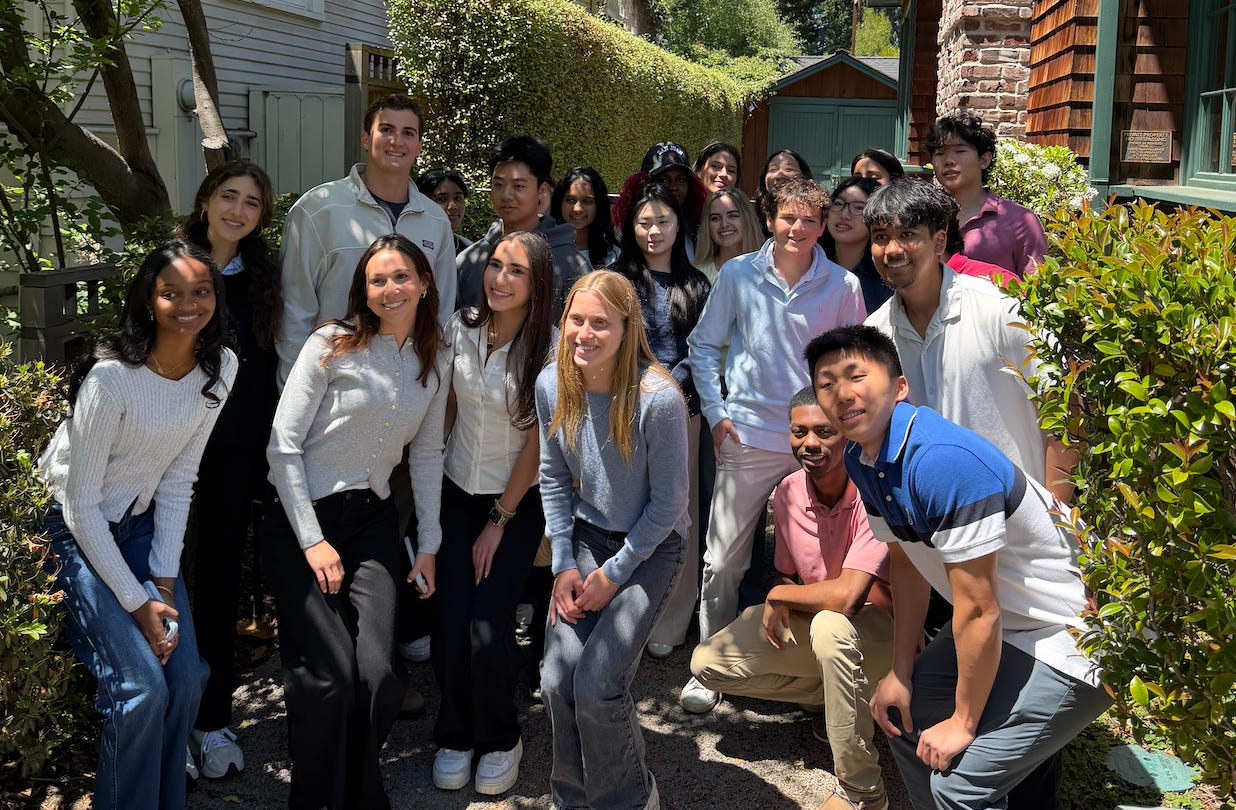
As I write this, we just wrapped up the first week of the Ronald & Carrie Ludwig Duke in Silicon Valley Program. And while I’m tempted to spend the next month using this space to brag about how great it is, I promise I won’t keep writing West Coast updates like I’m some sort of travel blogger.
However, I do want to take a moment to share one brief story about something that’s become a bit of a tradition.
Every time we bring a group of students out for Duke in Silicon Valley, one of the first visits we make is to the historic HP and Google Garages. For those of you who don’t know, the HP Garage is where David Hewlett and Bill Packard started their eponymous company back in 1939, and it’s now considered the “birthplace of Silicon Valley.” The Google Garage is where Larry Page and Sergey Brin first launched Google.
And as you can see from the photo at the top of this issue, these aren’t particularly auspicious places. In fact, visiting them is usually somewhat awkward and disruptive since it involves bringing a big tour bus and a bunch of students into a very quiet suburban neighborhood. It’s definitely raised more than a few eyebrows.
But that unsuspecting suburban setting is also a huge part of the point of the visit.
Sure, we spend the bulk of the program visiting the campuses of some of the largest and most successful tech companies in the world, and those campuses are wildly impressive. But I love bringing students to a place like the Google Garage and ask them to imagine what it would have felt like to be building Google back then. I mean, sure, today we hear “Google” and think of… well… Google. One of the most powerful companies on Earth. A product so dominant its name became a verb.
But none of that was guaranteed.
Back in 1998, it was just two graduate students working on a search engine in a garage. They weren’t surrounded by the Google mythology, and they certainly weren’t guaranteed any type of meaningful success. Heck, they didn’t even know if anyone would care. If anything, the startup probably looked a little ridiculous to outsiders. “You’re making another search engine?” doesn’t exactly sound like the beginning of a trillion-dollar company.
That’s the strange thing success does in hindsight. It compresses uncertainty. Once something works, we retroactively treat the outcome as inevitable, as though we should have seen it coming all along.
But entrepreneurship never feels inevitable while you’re inside it.
Instead, entrepreneurship feels awkward, unclear, and… small. It feels like wandering around a quiet suburban neighborhood trying to convince yourself something important might someday happen there.
That’s why I like taking students to the garages early in the program. I promise, it has nothing to do with romanticizing Silicon Valley mythology. It’s because I want them to understand how ordinary extraordinary things usually look at the beginning.
The startups that change industries rarely feel important at first. The founders rarely feel certain. And the environments where those companies begin often look laughably unimpressive compared to the stories we later tell about them. And that’s an important entrepreneurial lesson because most people quit long before anything looks meaningful. They assume that if success were really possible, it would already feel bigger, clearer, or more obvious.
But it usually doesn’t.
Remember that most of the time, building something meaningful just feels like doing weird work in unremarkable places while hoping the future eventually catches up to your vision.
-Aaron
Worth Your Time

As a professor doing my best to teach in the age of Gen AI, I’ve been thinking a lot about how my students can use it to supercharge their thinking rather than replace it.
In this article, notice how Mark Cuban draws a sharp distinction recently between “people who use AI so they do not have to learn anything, and people who use AI so they can learn everything.” Another way to think of it is the difference between using AI to optimize your workout versus sending AI to the gym for you. Only one of those approaches builds muscle…
And guess what Cuban calls the number 1 skill for entrepreneurs, employees, and students?
Curiosity.
Not prompting acumen. Not tool fluency. Curiosity.
For good or for bad, AI does not create a curiosity muscle. It just rewards whatever entrepreneurial mindset you already bring, and punishes the absence of it faster than any technology that came before.